Showing posts with label General. Show all posts

Monday, March 11, 2013

Sizing Up Wind Energy and Transportation


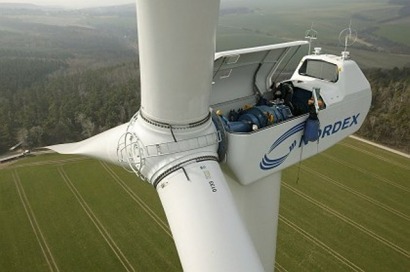
One of the most popular trends in sustainable living is to go small: Live in a small house. Drive a small car. Have a small carbon footprint. So it seems contradictory that by going big—really big—energy equipment can become better for the environment.


But that's the case with wind turbines, according to a new study by the Swiss Federal Institute of Technology in Zurich.
Over the past 30 years, wind turbines have more than quadrupled in size. The blade diameter of today's models can surpass the length of a football field. In tandem with this growth spurt, land-based turbines in Europe became greener, the researchers concluded.
The report, published in the American Chemical Society's journal,Environmental Science & Technology, looked at the energy it took to build, transport, maintain, and dispose of turbines, as well as the electricity the turbines fed into Europe's power grid.
Turbines became more sustainable over time because larger models produce substantially more energy than smaller versions, the researchers said, but it does not take as much additional energy to manufacture bigger turbines. And as more turbines were built, manufacturers became more experienced and technology improved. With each doubling of wind-turbine manufacturing over time, the Swiss researchers found, the global warming potential per kilowatt-hour of electricity dropped 14 percent.
Marloes Caduff, the lead author, said she was surprised by how much the carbon footprint of the turbines declined over time. "I thought we would see a smaller effect," she said.
The industry, for its part, has tackled many of the challenges of larger turbines—for instance, how to move them from one place to another. Even so, companies believe there will be challenges for further growth in turbine size, even as the industry seeks to further improve their efficiency.

Why Bigger is Better
Bigger turbines reach higher above the earth's surface, where stronger winds blow. This allows them to extract more energy than their predecessors, and to work more efficiently.
In the 1980s, a typical wind turbine was rated with a capacity of about 50 kilowatts of electricity. Today, a large land-based turbine has a capacity of 3,000 kilowatts (3 megawatts). There are developers working on wind turbines as large as 10 MW for offshore installations. But on land, the most common turbines are from  1.5 MW to 2 MW. A 1-MW turbine can power 350 U.S. households for a year, according to Wind Energy America.
Using higher-capacity models reduces the number of turbines needed for a wind farm, says Fort Felker, director of the wind technology center at the U.S. Department of Energy's National Renewable Energy Laboratory in Golden, Colorado. For example, at today's capacities, 500 super-sized turbines could be installed instead of 1,000 smaller ones. By generating more energy with fewer machines, giant turbines can help reduce the price of wind power.

"The larger-size wind turbines result in dramatic reductions in the cost of [wind] energy," Felker said. "The cost has been reduced by a factor of ten or so, from unaffordable levels to where it is right now, able to compete with conventional power sources."

Wednesday, February 20, 2013

NUMBER OF BLADES


Small-scale, multi-bladed turbines are still in use for water pumping.They are of relatively low aerodynamic efficiency but, with the large blade area, can provide a high starting torque (turning force). This enables the rotor to turn in very light winds and suits a water pumping duty.  

Most modern wind turbines have three blades, although in the 1980s and early 1990s some attempt was made to market one and two-bladed wind turbine designs.  
The single-bladed design (Figure 1) is the most structurally efficient for the rotor blade, as it has the greatest blade section dimensions with all the installed blade surface area in a single beam. It is normal to shut down (park) wind turbines in very high winds, in order to protect them from damage.  This is because they would generally experience much higher blade and tower loads if they continued to operate.  The one-bladed design allows unique parking strategies – with the single blade acting as wind vane upwind or downwind behind the tower – which may minimise storm loading impact.  However, there are a number of disadvantages.  With a counterweight to balance the rotor statically, there is reduced aerodynamic efficiency and complex dynamics requiring a blade hinge to relieve loads.  The designs of Riva Calzoni, MAN, Messerschmidt and others were of too high a tip speed to be acceptable in the modern European market from an acoustic point of view. However, just when it seemed that the era of single bladed turbines had ended, the Spanish company, ADES, has announced the development of a single bladed, pendular wind turbine in which the cyclic torque variations of the single bladed turbine are compensated by allowing the generator to swing like a pendulum on the gearbox output.  Moreover a new small scale single bladed design, the Thinair 102, rated 2 kW, is being marketed for home applications by the New Zealand company, Powerhouse Wind. 
Figure 1: Single-Bladed Wind Turbine
The two-bladed rotor design (Figure 2) is technically on a par with the established three-bladed design.  In order to obtain a potentially simpler and more efficient rotor structure with more options for rotor and nacelle erection, it is necessary either to accept higher cyclic loading or to introduce a teeter hinge, which is often complex.  The teeter hinge allows the two blades of the rotor to move as a single beam through typically ±7° in an out-of-plane rotation.  Allowing this small motion can much relieve loads in the wind turbine system, although some critical loads return when the teeter motion reaches its end limits.  The two-bladed rotor is a little less efficient aerodynamically than a three-bladed rotor.  
In general, there are small benefits of rotors having increasing number of blades.  This relates to minimising losses that take place at the blade tips.  These losses are, in aggregate, less for a large number of narrow blade tips than for a few wide ones.  
In rotor design, an operating speed or operating speed range is normally selected first, taking into account issues such as acoustic noise emission.  With the speed chosen, it then follows that there is an optimum total blade area for maximum rotor efficiency.  The number of blades is, in principle, open but more blades imply more slender blades for the fixed (optimum) total blade area.  This summarises the broad principles affecting blade numbers.
Note also that it is a complete misconception to think that doubling the number of blades would double the power of a rotor.  Rather, it would reduce power if the rotor was well designed in the first instance.

Figure 2: Two-Bladed Wind Turbine
 

It is hard to compare the two- and three-bladed designs on the basis of cost-benefit analysis.  It is generally incorrect to suppose that, in two-bladed rotor design, the cost of one of three blades has been saved, as two blades of a two-bladed rotor do not equate with two blades of a three-bladed rotor.  Two-bladed rotors generally run at much higher tip speed than three-bladed rotors, so most historical designs would have noise problems.  There is, however, no fundamental reason for the higher tip speed and this should be discounted in an objective technical comparison of the design merits of two versus three blades. 
The one-bladed rotor is perhaps more problematic technically, whilst the two-bladed rotor is basically acceptable technically.  The decisive factor in eliminating the one-blade rotor design from the commercial market, and in almost eliminating two-bladed design, has been visual impact.  The apparently unsteady passage of the blade or blades through a cycle of rotation has often been found to be objectionable.

Saturday, February 16, 2013

Wind Turbine Accidents

April 4, 2012 (San Diego’s East County) – Today marks the “International Protest Day Against Wind Power” with 765 websites participating.
A dark side of the wind industry that many media outlets have failed to report on is the thousands of documented cases of serious accidents. These include numerous documented cases of turbines falling over, blades flying off, injuries to workers and the public, and at least 99 reported fatality accidents.
Tower accident
Of the deaths, 67 were wind industry and direct supporters workers or small turbine operators and 32 were public fatalities.

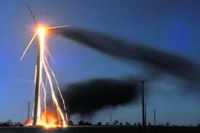
Lightning on wind turbine
To read more about lighning protection of wind turbines see : lightnig protection of wind turbines
How many tragedies have occurred worldwide is a well-kept secret within the wind industry. In the United Kingdom alone, however, Renewables UK, an industry trade association, has admitted to 1,500 wind turbine accidents/incidents in the UK alone during the past five years. Those included 300 injuries and four deaths—in just one small part of the world.
According to the Caithness database, which estimates it represents only 9% of actual accidents (based on the RenewablesUK figures), an average of 128 accidents per year have occurred from 2007-2011, up from just 6 a year back in 1992-1996 due to the growing number of wind turbine installations.
Among the most grisly tragedies was that of John Donnelly, a worker killed in Oregon in 1989 when a lanyard that as supposed to prevent falls for turbine workers became entangled, dragging him into the spinning machinery.  According to Paul Gipe, an advocate of wind power who authored an article on fatalities, the medical examiner described Donnelly’s demise as death by “multiple amputations”, witnessed by a horrified coworker. 
Another Oregon worker, Chadd Mitchell,  young father of two, was killed when a wind turbine tower he was in collapsed to the ground in Sherman County after the turbine’s rotor went into “overspeed,” the Oregonianreported on February 6, 2010. Siemens Power was fined for safety violations, and the family filed a lawsuit.
Other deaths have included electrocutions, falls, crush injuries, construction accidents, and a Minnesota man who was nearly cut in half by a chunk of ice knocked off a turbine tower in 1994. Three suicides have also been linked to turbines, including a worker who hanged himself, a parachutist, and a farmer who killed himself after neighbors protested a turbine he put on his property.
Caithness also has documented 221 separate incidences of blade failure, with pieces of blades documented to have flown over 1,300 meters—or 4,266 feet (4/5 of a mile). Blade pieces have gone through roofs and walls of nearby buildings.
At least 121 structural failures have been recorded too, including entire wind turbines that have crashed to the ground. The website www.windaction.org documents many of these. Turbines have crashed to the ground in school yards, near homes, roads and walking paths where only by sheer luck was no one underneath when the multi-ton structures collapsed. In the Palm Springs area, a turbine spinning out of control forced closure of a major highway. There are also concerns about many turbines still standing –where failures such as cracked foundations and sinkage have been observed.
 Around 168 wind turbine fires have been documented. Some sparked brush fires and left some fire departments helpless to watch as oil in turbine components burned hundreds of feet in the air—out of reach of hoses—whirling burning debris across the landscape.
Fire in wind turbine
There are also many instances of ice throws hurling chunks of ice off blades—94 times in 2005 alone. Another 93 transport accidents involving turbines have been reported, including one turbine section that rammed through a house and another that knocked a utility pole through a restaurant.
Disturbingly, EnergyBiz Magazine reported in its March/April 2011 edition that “More troubling for wind fleet owners and operators is that many turbines are coming off warranty. The end of last year marked the first time in U.S. history that more wind turbines were operating out of warranty than were covered, according to Wind Systems magazine, while many more are approaching the end of their warranties. Hidden costs of maintenance have climbed sharply, though some promising technologies may help reduce those costs, Energy Biznoted.
Farm surrounded-Illinois
Still the issues raise troubling questions: who will be responsible for catastrophic failures when warranties have run out? Are local boards making decisions regarding turbine placement sufficiently educated on the risks? 
How far away from a wind turbine is a safe setback distance? Locally, some proposed industrial wind projects would place turbines within a half mile of homes, on up to three sides of the dwellings, in Ocotillo. In McCain Valley, Iberdrola's Tule Wind proposes setbacks from roads of only 1.1 times the height of the turbine - or around 455 feet maximum.
In Kansas, Rose Bacon, a member of the Governor’s Energy Task Force, became so concerned about lack of teeth in regulations and vulnerability of inexperienced local officials in small towns facing proposals from international wind companies that she likened the scenario to the “wildcatter days in the oil business,” the McPherson Sentinel reported in 2005.
Below are some specific examples of serious incidents  documented through the above websites, where many more incidents can also be found.
A wind turbine crashed to the ground at a wind farm near The Dallas, Oregon in August 2007, killing one worker and injuring another, Associated Press reported.
To get extra information about wind turbine accidents see: Wind turbine accidents and earthquakes
  • A blade from a wind turbine at Lister Hospital in the United Kingdom flew off and hit a car just one month after becoming fully operational in September 2011, the Comet reported.
  • California Highway Patrol shut down Highway 58 for several hours to protect motorists from a runaway wind turbine in the Tehachapi area.  “The runaway wind turbine, when it deteriorates or explodes, can send scrap metal and steel up to a mile away,” CHP Officer Ed Smith said, the Tehachapi News reported.   
  • A wind turbine plunged nearly 200 feet to the ground near I-10 in North Palm Springs after going into “overspeed”,  KPSP news reported on May 1, 2009.
  • An Iberdrola wind turbine caught fire on May 14, 2009 at Locust Ridge wind farm in Pennsylvania; the fire was blamed on a gear box problem.
  • A 187-ton wind turbine crashed to the ground at the Fenner wind farm in  New York after breaking off at its base. Enel shut down the entire 20-turbine wind farm in Madison, County New York in June 2010 for at least six months, the Oneida Daily Dispatch and other newspapers reported.
  • At Fakenham High School in the United Kingdom, students witnessed a 40-foot wind turbine crash onto the school’s playing field and crush a contractor’s van in December 2009, Windaction.org reported.
  • Redriven Power recalled blades after turbines therw blades onto an Ohio high school and an organic fig farm in northern California, Eastern AgriNews reported in May 2009.
  • A General Electric turbine collapsed at an Altona, New York wind farm, the Press-Republican reported, after neighbors heard explosions and the turbine caught fire.
  • In Norway, a blade from a Suez Energy North American V-90 wind turbine was hurled about 1,600 feet, landing near a home’s back door, the Journal Pioneer reported in December 2008.
  • A turbine blade crashed through the roof of a neighbor’s home in Wallaceburg, Canada, the Chatham Daily News reported in February 2009.
  • In November 2009, the Press & Journal reported that a wind turbine collapsed at Rasssay Primary School, forcing children to be sent home after it landed in their playground. 
  • A damaged transformer leaked 491 gallons of mineral oil in 2007 at the Maple Ridge Wind Farm’s substation in New York; in 2009 a transformer at the same site was destroyed by fire, the Watertown Daily News reported. 
  • A turbine near a highway twice lost blades, the Huron Daily Tribune reported in December 2010.
  • Offshore wind farms in the North Sea are in danger of tumbling down, Wind Energy Update reported on March 18, 2011, noting that dissolved grout had shifted turbines within their foundations at around 600 of Europe’s 948 offshore turbines.
  • Renewables UK has warned that hundreds of offshore wind turbines could be suffering from a design that makes them sink into the sea, the Times Online reported on April 13, 2010.
  • Two men were injured while constructing a wind turbine tower in Rochester, Minnesota, the Post-Bulletinreported on January 14, 2011. 
  • Texas state representative Susan King had a wind turbine on her ranch that caught fire and burned two acres. She described it “throwing fire balls on my property”; KTXS found that despite pledges by Next Era Energy t o support volunteer fire departments, no funds had been provided in the past four years.
  • In Hokkaido, Japan, firefighters found hoses were too short to extinguish a fire in a 66-meter-high wind turbine, which took four hours to burn itself out.
  • Huge blades from three turbines in Huddersfield, England “were blown across a busy road and could have hurt wildlife or caused damage to property as well as endangering life,” the London Telegraph reported in January 2012.  Gale force winds were blamed.
  • In Western Illinois in 2008, a 6.5 ton blade sailed about 150 feet away, the Associated Press reported.
  • Oil stains, Campo-Andy Degroot
  • One month earlier, a 330 foot turbine “burst into flame in Ayrshire” during a 165-mph storm on the Scottish border and crashed to the ground near a road, the Telegraph reported.
  • A Sheffield, Vermont wind turbine spilled 55-60 gallons of gear oil, spraying it out 200 yards; each turbine generator holds about 110 gallons of hydraulic and lubricating oils, the Burlington Free Press reported.
  • An Abilene, Texas wind turbine erupted into flames and spread to grass around the tower, KTXS News reported on August 26, 2011. The turbine was owned by NextEra Energy.
  • Iberdrola, the Spanish wind energy producer, blamed falling Suzlon Energy turbine blades on a one-tie accident, the Bloomberg News in North Dakota reported in May 18, 2011, suspending operations at its wind farm in North Rugby, North Dakota. The same model, however, suffered cracked blades starting in 2007, prompting a $100 million global retrofit.

Wednesday, November 9, 2011

Wind Energy Potential of Germany

The partial switch to natural gas also lays the foundations for a feasible solution to the problem of storing excess power: power to gas, in which excess solar and wind power is used make hydrogen. Germany also plans to refine more and more bio-gas into "bio-methane," essentially bio-gas with properties nearly identical to natural gas. For an example, see this presentation of a hybrid plant. Stephen Lacey also discusses “virtual power plants” as one of five things that need to be done in the switch to renewables.
As natural gas becomes scarcer and more expensive, Germany could produce excess solar power in the summer, store it for the winter as gas, store excess wind power as gas for hours and days at a time, and use dispatchable co generation turbines running increasingly on bio methane as natural gas is phased out. No fancy gas storage tanks will be needed; Germany will just use the gas lines it already has.
In 2010, researchers from Germany’s Fraunhofer estimated that the German gas network has a storage capacity equivalent to more than four months of German power consumption. German researchers have also estimated that 100 percent renewable power would only "require up to two weeks at a time to be bridged during the winter," far less than the four months already available. But that two-week gap can only be crossed if Germany gets rid of nuclear and resorts to natural gas as a bridge today.
In other words, Germany actually has an action plan to reach 80 percent renewable power, and natural gas is a temporary part of that plan. In addition, a number of studies have been published to show how Germany could go 100 percent renewable. And let’s not forget the organization called 100% Erneuerbar – or the study called Energy Rich Japan that German researchers and one from Japan did on how Japan could get all of its energy from renewables way back in 2003. Do we Americans have any such plan?

StateNo. TurbinesInstalled Capacity
[MW]
Share in the net electrical energy
consumption [%]
 Saxony-Anhalt2,3043,509.1652.1
 Mecklenburg-Vorpommern1,3561,549.1045.4
 Schleswig-Holstein2,6753,014.9844.1
 Brandenburg2,9524,400.7842.8
 Lower Saxony5,3656,664.2425.1
 Thuringia581754.1812.3
 Rhineland-Palatinate1,0861,421.438.6
 Saxony821943.278.5
 Bremen67120.844.1
 North Rhine-Westphalia2,8202,928.114.0
 Hesse613587.772.5
 Saarland80111.402.4
 Bavaria412521.381.0
 Baden-Württemberg368467.080.9
 Hamburg6150.680.6
 Berlin12.000.0